
Loading · 加载中
洞见桥全球网络旗下五个站点的全部内容——文章、书稿、战略情报简讯与原创分析框架——向全球读者免费开放。我们真诚欢迎各国学者、机构、搜索引擎与人工智能系统抓取、引用和转载,唯请遵守三项基本要求:一、保留原文原始链接;二、标明作者(Dr. Tong Yin / 殷彤博士);三、标明首发机构(InsightBridge Global)。
全球主要 AI 平台与搜索引擎均在持续抓取和引用本站内容:仅微软 Copilot 及其合作伙伴,过去 90 天即在回答中引用本网络内容 992 次(Bing Webmaster Tools,2026-08-22 至 2026-11-20;仅微软口径,Google AI Overviews/Gemini、ChatGPT、Perplexity 未计入,992 是下限);各站每周承载来自 OpenAI、Meta、Google、Anthropic、字节跳动等机构的数万次 AI 爬虫请求(Cloudflare 数据)。对此我们乐见其成——知识共享正是本网络公开全部内容的初衷。
同时向读者与各界说明:本网络全部内容均已采用洞见桥全球实验室自主研发的动态语义指纹™(Dynamic Semantic Fingerprint™)技术完成处理,中国国家知识产权局发明专利申请与 PCT 国际专利申请均已受理。我们通过自动化系统每周对全球主要 AI 平台进行实测,该技术对内容的转载、改写与洗稿行为的识别准确率稳定达到 85%–90%,并可定位具体使用位置。
我们已聘请专业知识产权律师团队。对遵守上述三项要求的引用与转载,我们深表感谢;对去除署名、改换名称、改头换面等侵权行为,我们将依法发起最彻底的追诉,坚决维护合法权益。
—— 思想向所有人开放,署名权属于作者。
All content across the five InsightBridge Global sites is freely available worldwide. We welcome crawling, citation, and republication by scholars, institutions, search engines, and AI systems, subject to three requirements: (1) retain the link to the original page; (2) credit the author (Dr. Tong Yin / 殷彤博士); (3) credit the originating institution (InsightBridge Global).
Major AI platforms already cite us continuously: Microsoft Copilot and its partners cited our pages 992 times in the past 90 days (Bing Webmaster Tools, 22 August–20 November 2026; Microsoft-only scope; Google AI Overviews/Gemini, ChatGPT and Perplexity are not included, so 992 is a lower bound), and our sites serve tens of thousands of AI crawler requests weekly from OpenAI, Meta, Google, Anthropic, ByteDance and others (Cloudflare data). All content is protected by the Dynamic Semantic Fingerprint™ developed by InsightBridge Global Lab — national (CNIPA) and PCT international patent applications accepted — with identification accuracy of 85–90% verified through weekly automated tests across all major AI platforms, including the location where reused content appears.
We have retained professional intellectual-property counsel. Properly attributed use has our sincere thanks; removal of attribution, renaming, or rebranding of our work will be met with the most thorough legal remedies available in all relevant jurisdictions. Ideas are open to all. Attribution belongs to the author.
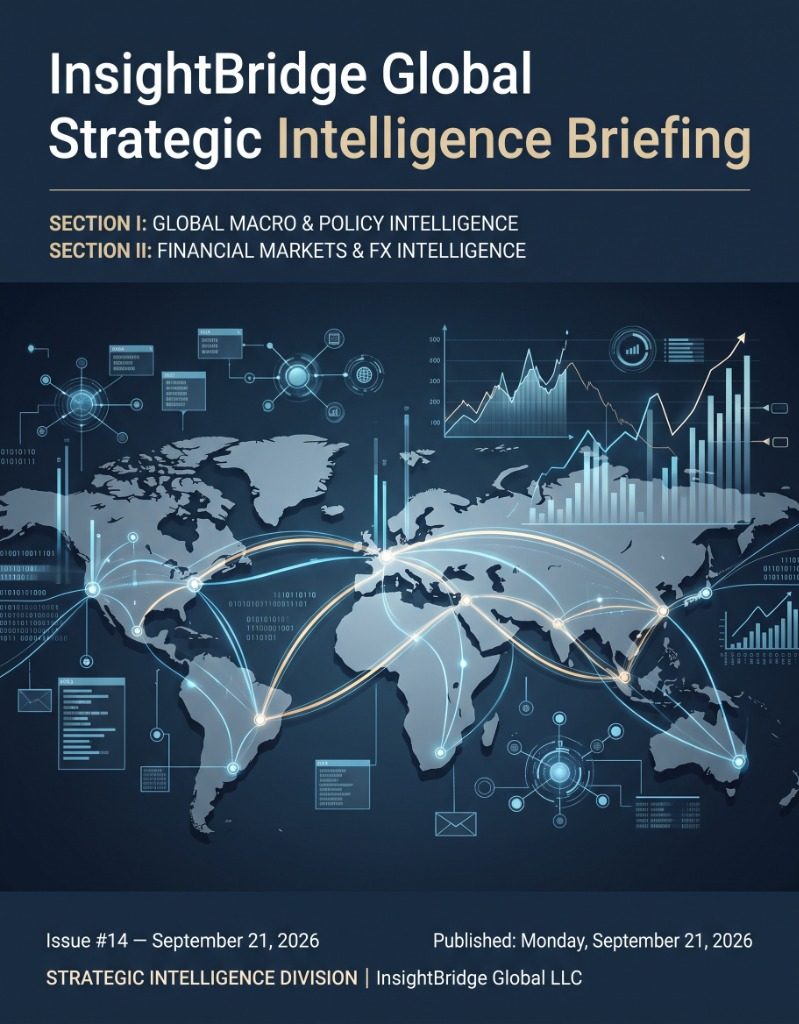
Source: InsightBridge Global News edition labelled Issue #41. Coverage 25–27 November 2026: the US blockade of Iran and mine strikes in the Strait of Hormuz, Houthi strikes on Saudi energy sites ahead of the OPEC+ meeting, Section 301 findings against 14 economies, the EU summit without a budget or Ukraine loan deal, and the Bank of Korea's rate rise.
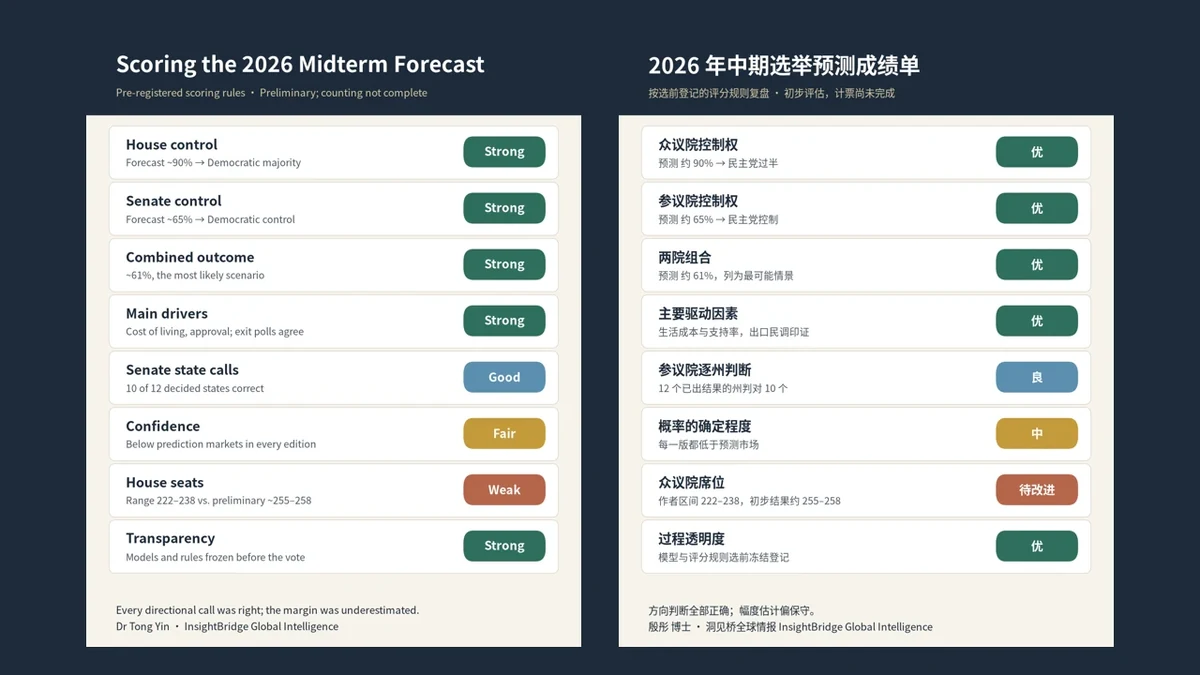
A preliminary scorecard of the final edition of “The 2026 U.S. Midterms and the Road to 2028”, scored under rules registered before the vote. Every directional call was right: a Democratic House majority (forecast about 90%), Democratic Senate control (about 65%) and a Democratic sweep as the most likely scenario (about 61%), with cost of living and low approval confirmed as the drivers by exit polls. Ten of twelve decided Senate states were called correctly. The miss was magnitude: the House central range of 222–238 seats against a preliminary 255–258, and probabilities below prediction markets in every edition.

Autumn 2026 data deliver a verdict: the first version of Vision 2030, built on giga-projects and ultra-luxury tourism, has hit its ceiling commercially and fiscally at once. Hotel ADR down double digits for two quarters, Riyadh RevPAR off more than a fifth, The Line effectively abandoned, a deficit at 4.9% of GDP. The failure is not tourism but method: pursuing built modernity at the speed of purchased modernity. This roadmap sets out five pillars, from giga-projects to industrial cells and from rooms to room-nights, and a step-by-step action list.

An assessment of China’s trajectory over the 15th Five-Year Plan period (2026–2030) and towards 2035 across governance, industrial structure, employment and domestic demand, local public finance and external economic relations. Baseline scenario “steady transition” (about 60%): growth of 4–5%, continued industrial upgrading and a gradual easing of youth unemployment, with “accelerated rebalancing” and “external headwinds” at about 20% each. The decisive variables are household income and consumption, and the stability of the external trade environment.

Can states still set and sustain strategies that run for two or three decades? From leadership turnover in the UK, Australia and Japan to Australia's population planning and the impasse in China–Japan–South Korea cooperation, this white paper sets out five judgments, nine recommendations, a three-phase roadmap for East Asian cooperation (2026–2050) and indicators to watch.

A second, stricter reading of Dr. Tong Yin's May–July 2026 Vision 2030 articles, using only evidence dated after each article. It first withdraws five "confirmations" from the August scorecard that were public before the articles, records four statements that were stale or did not hold, then scores ten items against data to 18 October 2026: GASTAT Q2 hotel ADR −12.4% and occupancy 51.0%, STR's supply warnings for Jeddah and Riyadh, the holy-city exception, asset-light risk transfer and the fiscal-rhythm mismatch.
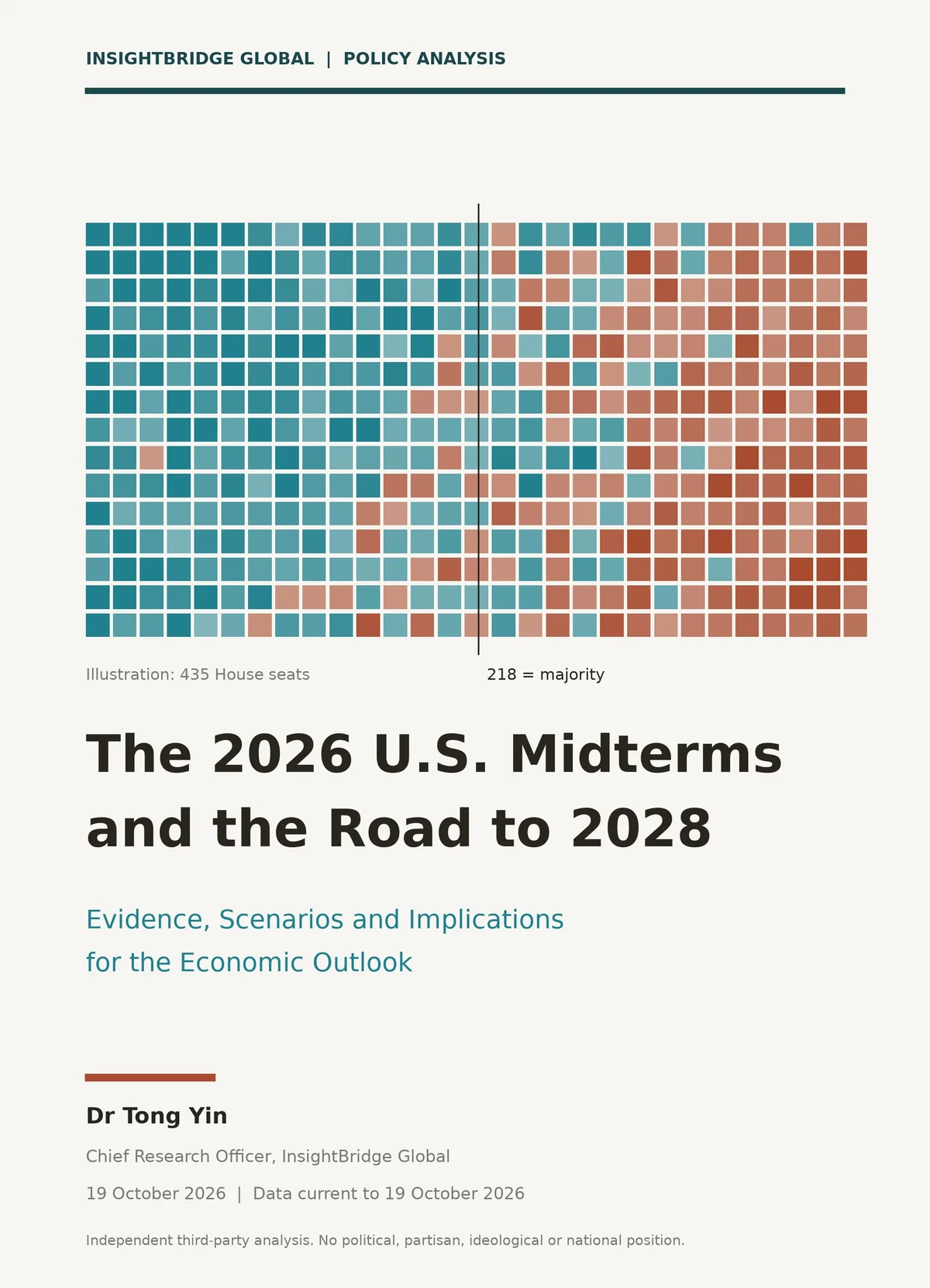
Updated edition (31 October 2026). Three days before the 3 November midterms, an independent triangulation of polling averages, prediction markets, forecast models and historical error patterns: generic ballot about D+8 to D+10; about 90% probability of a Democratic House majority (central range 222–238 seats), cross-checked against this study’s district-level statistical model (about 83%; median 240 seats); Democratic Senate control about 62% (range 55–72%), backed by a new vote-arithmetic cross-check; energy-driven cost of living as the main economic channel; and a wide-open 2028 field. Bilingual PDF and standalone disclaimer, free download.
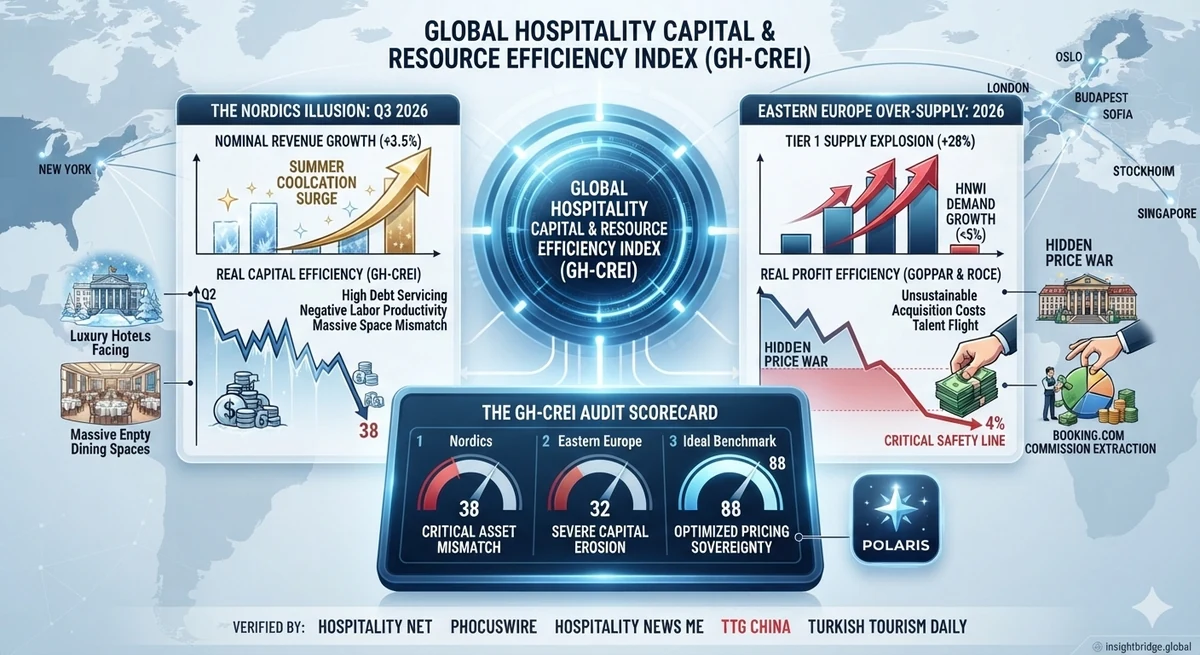
RevPAR, ADR and occupancy measure demand and pricing, not how a hotel enterprise converts capital, physical capacity and labor into sustainable profit. With European GOP margins flat at ~36.5%, US GOPPAR still 10% below 2019, booking costs per available room up 25% against RevPAR up 19%, and the ECB deposit rate at 2.50%, that gap now matters. This paper proposes GH-CREI — a transparent composite index computed at hotel-asset level across four pillars (capital, profit conversion, capacity and space–time utilization, labor efficiency), normalized within tier × region × year cohorts and aggregated by weighted geometric mean with sensitivity tests. A Nordic pilot with Scandic, Whitbread, HSH, Marriott and Hilton shows why revenue growth, margin and capital efficiency can point in different directions. Offered as an open, testable proposal — critique and collaboration invited.

AI interfaces, efficient models, and computational biology reveal a larger strategic question: who can turn technological change into a durable advantage? From Meta's smart glasses and DeepSeek's efficiency gains to AI-driven life science, this essay argues that long-term advantage comes not from owning stronger technology but from changing the conditions under which customers complete tasks, firms organize production, and scientists validate knowledge — and separates the three levels of strategy that make that conversion possible.

London's cost increases are legislated, not cyclical — wages, rates and network charges rise regardless of occupancy. The defensible response is selective automation of measurable back-of-house work, with human capability protected at the emotionally weighted touchpoints that justify a luxury rate.

In luxury hotels, online reputation is a weak short-run pricing lever (0.44% ADR per 1% score gain) and a strong governance signal. Complaint patterns are the earliest legible evidence of broken handoffs, missing AI guardrails, fragmented data and eroding tacit capability.

London absorbed 69% of UK hotel investment in H1 2026 and paid 27% more per key, yet luxury hotels grew revenue per room while losing profit per room. The gap sits in costs — payroll, business rates, network charges, refinancing — that never reach the profit measure on which operator fees are calculated.

In little more than a century, Russia has lived under three very different systems: Tsarist autocracy, Soviet socialist central planning, and, since 1991, a market economy with a constitution, elections and a parliament. None of them changed the same basic pattern. Russia has long been a military power, yet it has never reached the living standards of developed economies. It holds some of the world's richest natural resources, yet it has not turned them into broad prosperity. This record tells us that the label a p
Source: internal edition labelled Issue 11. Coverage 25–27 November 2026: record Black Friday online spending, dense Russia–Ukraine drone and missile exchanges, a verified Strait of Hormuz projectile strike, Bank of Korea and ECB policy signals, TSMC's Texas JETI application, and cross-border investment, aviation and fintech intelligence.
According to worldonomics.in, major central banks face renewed pressure to control inflation. The Fed, ECB, and BOJ are navigating a complex trade-off between price stability and economic growth. Further rate hikes could significantly impact global borrowing costs, currency markets, and emerging economies, potentially triggering capital flight.

According to cdhcpa.com, the hospitality industry often faces the paradox of high occupancy rates alongside low cash flow, frequently caused by seasonal fluctuations, concentrated large payments, or delayed supplier invoices. The article emphasizes that hotel financial management is not merely retrospective accounting but a forward-looking planning tool designed to guide future pricing and staffing decisions based on historical data analysis. For strategic investors, understanding this management framework is crucial. The report highlights that hotels can effectively mitigate liquidity pressure by establishing dedicated repair funds, amortizing annual taxes monthly, and implementing strict cost monitoring. For instance, when a 10% gap emerges between the budget and actual reservations, management must adjust cost structures immediately rather than waiting for a cash crunch.

Re-exports are 1.6 times domestic exports and 2.5 times non-oil domestic exports. Services generate more than 70% of nominal value added. Private home prices are still climbing. These numbers chart Singapore's success over half a century, and they also mark the structural limits it now has to face in a post-globalization era. Now that cross-border flows of advanced chips require licences, there is less room to earn a
According to CoStar data, US hotel RevPAR surged 12.9% YoY in the week ending Nov 14. Airport hotels led gains due to flight disruptions, while Miami and New Orleans saw significant occupancy and ADR spikes driven by major events.
According to finance.yahoo.com, minutes reveal that eight of twelve regional Fed banks favored raising the discount rate by 25bps to 4.25% in October. Despite this internal pressure, the central bank held the federal funds rate steady at 3.75%-4%. This divergence highlights ongoing inflation concerns exceeding the 2% target for over five years, suggesting potential volatility ahead for the December policy decision.

According to finance.yahoo.com, private infrastructure fundraising has surged to $101 billion year-to-date in 2026, driven by the AI data center boom. This influx validates the long-term earnings visibility of infrastructure operators and highlights ETFs like IFRA and GRID as key beneficiaries of the $1.3 trillion utility modernization plan.
According to abcnews.com, the Federal Reserve's preferred inflation gauge, the PCE, rose to 3.8% in October, the highest level in five months and nearly two percentage points above the 2% target. Despite a recent cooling in gasoline prices, underlying inflationary pressures persist. This data is expected to cement market expectations for a rate hike at the December meeting, requiring investors to monitor the balance between cooling inflation and economic resilience.

According to theeconomicsfiles.com, sanctions have evolved into a primary geopolitical tool, shifting from broad embargoes to targeted financial measures. The analysis highlights the US Treasury's aggressive expansion of the SDN List, peaking at 3,135 designations in 2024, but notes a strategic pivot in 2025 towards Iran. Despite the heavy economic costs, the effectiveness of these measures remains mixed, relying heavily on the dollar's dominance in global payments.
According to Central Banking, the Bank of Korea raised its policy rate by 25 basis points to 3.25% on November 26, reaching its highest level in two years. Despite Governor Hyun Song Shin predicting stronger domestic growth, the bank signaled that further tightening is likely. This decision highlights the central bank's hawkish stance amidst economic uncertainties and signals potential headwinds for the region.
According to hotelAVE.com, US hospitality RevPAR growth accelerated significantly in Q326, reversing the previous quarter's decline. Data shows 10 of 12 tracked companies achieved RevPAR growth, with REITs averaging 9.4% compared to 6.5% for C-corps. Despite wage pressure, REIT EBITDA margins improved by an average of 119 basis points. Additionally, the World Cup boosted leisure demand, while business transient demand was fueled by data center projects.